
"Tell me about yourself" is not a trap. It is a warm-up you have not practiced.
Published

How to answer tell me about yourself: a present, past and next structure, how long to go, what to leave out, with advice from Harvard, Yale and LSE.
The interviewer smiles and says, "So, tell me about yourself." Your brain offers three options: recite your resume, tell your life story, or say "um" for a very long time.
It is the easiest question in the interview and somehow the one that makes people sweat. It comes first, before you have had a chance to settle, and it is so open that every possible answer feels like the wrong one.
Here is the quiet truth under all the advice: they are not asking for your biography. They want a short, clear start to the conversation, and a sense of how your background connects to this job.
What they are actually asking
Harvard's career center (in a post republished from Forage) describes the question as a chance to ease into the conversation while the interviewer gets a quick sense of who you are and how your background fits the role. It also shows how clearly you can explain your own experience.
That is a much smaller job than "summarize your whole existence." You are picking a few true things and putting them in order.
The same question hides behind other wording: "walk me through your resume," "tell me about your background," "what should I know about you that is not on your resume?" Prepare once and you are ready for all of them.
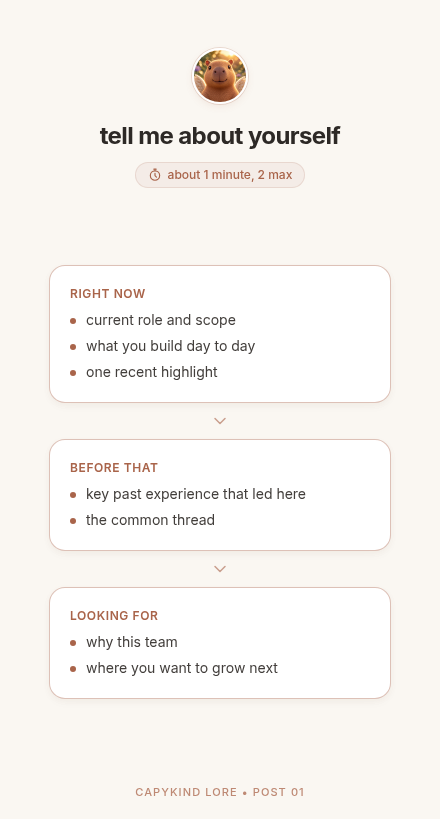
The shape that works: present, past, next
Most university career offices land on the same three-part structure. Harvard's version is past, present and future, and it says either order works as long as the answer feels like a story. The London School of Economics suggests starting with the present day and working backwards.
A plain version you can adapt:
Right now I am [current role or situation], where I [one true, relevant thing you do]. Before that I [one step that explains how you got here]. I am looking for [the kind of work this role is], because [one honest reason].
Three sentences. Say them out loud and you will hear that it takes well under a minute.
How long is too long
Career offices give ranges, not a law. Yale's Office of Career Strategy says your story should be under two minutes. The Harvard post says most answers fit in about 30 to 90 seconds. LSE says there is no set length, and that around two minutes is the right area.
So aim for about a minute, and treat two as the ceiling. If you are still going after that, you are probably reciting your resume.
Do not read your resume back to them
They already have it. Harvard's post says the interviewer has your resume and cover letter and likely your LinkedIn, so you are not starting from zero. Use the answer to add what the page cannot show: why you moved, what a project taught you, what you want more of.
Yale's guidance says to avoid too much personal history and to highlight strengths that will help interviewers ask follow-up questions. That is the best reason to leave a little unsaid. A good answer gives them something to pull on.
Two models if you want a skeleton
If past, present, next feels too loose, LSE's SEAT model gives you four slots: Skills, Experience, Achievement, and Type of person who. It also offers Professional, Academic, Personal as an alternative.
You do not need to use every slot. Pick the two or three that fit the job. A specific achievement, with a sentence on why it mattered to you, tells them more than a list of adjectives.
If you are early in your career
Experience does not have to be a paid job. LSE says it can include work shadowing, volunteering, competitions and live projects, and that your academic background can make up much of the answer when you have little work history. Say what you did and what you owned, not what you were exposed to.
If you are changing fields
This part is our suggestion, not a career office rule. Use the same shape, and let the middle step be the bridge: one true thing from your old work that the new role also needs. Then say plainly what drew you to the new field. Skip the apology. A career change is a reason, not a flaw.
Make it fit this job
The same answer should not go to every interview. Change the last sentence. Name the skill, team or problem that made you apply, and make sure it is true. If you cannot say why you want this role, that is useful information for you too.
Practice it out loud, not word for word
Yale warns against writing out and memorizing every word, because it sounds rehearsed. Write a few bullets instead: where you are now, one step that explains how you got there, what you want next. Say them to a friend, or to your phone. Cut anything that makes you wander.
Your first draft will be too long. Everyone's is. Cut the second job nobody asked about, the reason you almost studied something else, and the apology at the start.
Nerves are not a verdict
If your mind blanks, you can say "let me start with where I am now" and take it from there. A short pause is fine. Interviewers expect you to be a little nervous. One awkward opening does not decide the interview.
If you want a worksheet to build your version, use our tell me about yourself worksheet. It has fill-in prompts and a checklist, and nothing in it is written for you.
Not hearing back after you apply is a different kind of stress. For that, see what ghosting after applying actually means, and the follow-up guide. And if your resume is not getting you to the interview at all, start with the ATS resume guide.
Never job hunt alone.
Sources are linked beside the claims they support. This article is general information, not medical, legal or immigration advice.